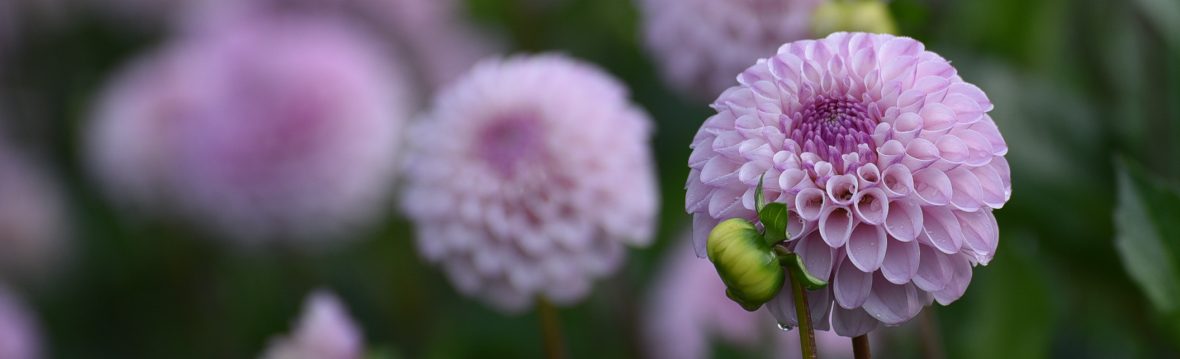
Dahlia

I told a friend…The Dahlia Dish, March 25, 2024

One of the things that fascinates us about dahlia blooms is that there are so many beautiful varieties that haven’t or never seem to “make it big”. They take their time to catch on. They sit a little longer on the shelves, they wait like wallflowers for an invite to dance, they might be the last players to get picked to play on the team…Why?

Dahlia Bargaly Blush

The visual appeal of a flower might be a combination of preference for just two qualities: colour and form. The functional appeal of a flower is how well it serves the needs of the grower in the garden and the vase: think stem length, bloom time, “floriferosity”, vase life, tubers and also colour and form.

If a bloom meets both visual and functional appeal is it guaranteed to be a winner? Is it going to hit the big times? Is it going to be the next Hollywood star in your bouquets and gardens? Maybe! Much more likely if it gets airtime! And much much more likely if the hype is not an empty promise that eventually sends the bloom down the road of ambiguity.

The volume of street chatter needs to get loud enough for dahlia growers to hear the call of a dahlia name more than once or twice and in a favourable tone. Often this chatter starts from a dahlia society or from a dahlia show where top prizes are coveted. Word of mouth is powerful! Remember that fabulous Faberge Organics Shampoo TV commercial starring actress Heather Locklear? “…I liked it so much I told 2 friends about it, and they told 2 friends, and so on, and so on, and so on”… that very same phenomenon happens with dahlias…

Dahlia Cherish

Dahlias that are on either side of the limelight are excellent choices for the vase and garden because they can usually be found at reasonable and in some cases low prices whereas those unicorns directly under the bright lights of stardom can cost a pretty penny, an arm or leg, maybe even your firstborn! Varieties on the bleeding edge of limelight are usually lesser known or new to the scene, while classic varieties that were once in the limelight have been around for awhile, are well known, readily available and have great qualities. Classics are a fantastic choice for new growers and seasoned growers too if they’ve never graced your garden.

2023-036 Medeek Meadows

A few varieties that we think are on the bleeding edge of limelight because of their visual and functional appeal, relative scarcity or obscurity and incredible qualities include: Bargaly Blush, Island View Moon, Cherish, Clearview Peachy, Aurora’s Kiss, Daddy’s Girl, After Dusk, Jabberbox and Ferncliff Classy.

A few solid classics that we adore and love to grow include: Carl Chilson, Ivanetti, Cornel, Robin Hood, Jowey Paula, Nijinsky, Just Peachy, and Snoho Sonia.

Dahlia Jowey Paula

Remember! The beautiful dahlias on both sides of the limelight are often just as incredible as the current “stars” and “unicorns”! Tell a friend!!!

Grow Beautiful Dahlias!

Enjoy the Dahlia!

Dahlia
Dahlia

All the ways to mix up dahlia varieties… The Dahlia Dish January 14, 2024

The humble gardener knows that even with years of experience growing dahlias its dead easy to mix up tubers leading to unknown and mislabelled varieties. There are folks who aren’t at all interested in tracking the names of the dahlia varieties they grow. If you’re in this group, you still might find it handy to label varieties according to height and colour so you know where best to plant them in your garden (i.e. short pink vs tall pink is about all you need on the label). Then there are folks who meticulously label and track every variety by name and number (call me crazy but count me in!). I need to know who’s who in my zoo… I love the names! A name has meaning – it has a story – familiarity – and maybe even gives our gardens a bit of personality!

Buckets of Dahlia Blooms

Its almost impossible to grow just a single variety of dahlia. It can be done, but why would anyone want to? …I’m not judging you’re judging 😉 … Back to the topic of this post, mixing up tubers. You’ll never do it if you only grow one variety!

Top 10+ ways to mix ’em up (in no particular order of “likelihood”)

  1. Buying tubers
    • Somebody else did it! Somebody already mixed up the tubers before you got a hold of them! Instead of seeing the beautiful soft yellow bloom of “Cherish” gracing your garden for the first time, you find yourself scratching your head gazing at a tall peachy pink beauty and wondering what the heck is this?
  2. Planting time
    • Mapping mistakes! You didn’t plant “Jabberbox” where you planned to and then you didn’t update your map and then you forgot what you did in the spring and then “Carl Chilson” shows up where Jabberbox was supposed to be… summertime gets busy!
    • Most gardeners do not plant their dahlias in rows with 1 variety per row and marked/mapped accordingly. Maybe your dahlias are sprinkled throughout your various garden beds beautifying your landscape over the summer. Mapping along with a labelled tuber or a labelled stake by each dahlia can help you keep things straight.
  3. Verification and correction of mistakes
    • When the blooms are bountiful, it’s the perfect time to check that labels match varieties and correct errors. If you have errors and don’t fix them during the blooming season, you won’t get another chance and will be more likely to perpetuate the mix ups next season and possibly for other people if you’re sharing your bounty of tubers.
  4. Digging
    • Remember when it comes time to dig up the dahlias in the fall, there’s often a good chance that the blooms are long gone. While tubers can have “distinguishing” characteristics, they usually aren’t obvious enough to determine what variety you’ve just dug up. Once the blooms are gone there isn’t much else aside from a good labelling/mapping system to identify the variety. If you’re growing multiple varieties in the same garden beds, a good labelling system is helpful.
    • Digging and processing one variety at a time will minimize the chance of mix ups
  5. Processing & Packing for storage
    • Again processing one variety at a time helps to minimize mixups
    • If you come across a stray tuber or clump of tubers that you’re not positive “belongs”, make a note of it and label as “mystery” accordingly
    • Watch out for spills! Sometimes the work area can get crowded! Safety first! Minimize tripping hazards. Carry only one tray of one variety at a time! You wouldn’t be the first to dump a tray of “healing” tubers that lands in another tray of another variety.
    • Avoid placing multiple varieties in the same bin! Stick to one variety per bin. Label each bin and place another label inside the bin with the tubers.
    • Be wary of old labels on bins. Plastic storage bins should be washed after every use and old labels removed.
  6. Winter Storage
    • Always a good practice to check on your tubers from time to time during the winter months to ensure they’re storing well. As with digging and processing, when checking tubers in storage, check one variety at a time to minimize opportunity for mix ups.
  7. Multi-tasking
    • One job at a time!
    • If you think you’ll remember, you won’t! If you think you’ll forget, you will!
  8. Labels on plants
    • not all labelling methods work well out in the garden. Regular sharpies work “ok” but not great and are very prone to fading away to the point of being illegible at the end of the season when you really need to be able to read the label. The finer the tip, the faster the fade. Use an indelible ink permanent “Nursery Marker” – they are the bomb. Whether they are in direct sunlight or hidden in the ground – they are 100% legible at the end of the season.
    • label one variety at a time! Applying the wrong label to the wrong tuber has been done before!
    • We like to use a combination of different coloured surveyors flagging tape on plants when needed, and we use wired vinyl labels on tubers before we plant them.
  9. Cuttings
    • mislabelling a tuber is one thing…
    • when you take cuttings from a mislabelled tuber – you unknowingly propagate 5 plants of a variety – but which variety? Maybe you’ll get 5 “Crazy Love” plants instead of 5 “Peaches N Cream” plants! Be cautious – it can happen. The risk can be higher with cuttings taken from “new to you” tubers which you have never grown before and thus never had the chance to verify the blooms match the name.
    • mixups in the trays can also happen by taking a cutting and putting it in the wrong tray to root…
  10. All the varieties!
    • the more varieties you grow – the more important it may be to develop good habits and good systems if you want to keep an accurate inventory.
  11. Helpers
    • Pets and little people have been known to move things around and maybe even chew up labels! Double or triple labelling redundancy can be helpful 😉

At the end of the day… find a system that works for you! Grow beautiful dahlias! Enjoy the blooms and share the joy!

dahlia tubers canada
Dahlia

Dahlia tubers or cuttings or seeds?…the Dahlia Dish January 8, 2024

All the ways to grow beautiful dahlia blooms… from tubers, cuttings, or seeds? Which way and why?

Dahlia Jabberbox

Dahlia Tubers

Our #1 choice. Growing dahlias from tubers is the easiest and most reliable way to grow dahlias “true” to variety. This is by far our preferred way to grow dahlias. The benefits:

  • easy as pie – they require the least of amount of work, equipment, supplies, and time.
  • they are more forgiving than a cutting. When you acquire new tubers, they don’t usually require too much coddling from the time you receive them to the time you can plant them (after your frost free date). Store them in a cool, dark area until you’re ready to plant. Keep an eye on the humidity so that they don’t shrivel up if its too dry. Plant them out when the weather looks favourable.
  • if you happen to get a late frost after you’ve planted your tubers where the frost kills off the new growth, as long as the tuber is in good shape it will usually do its best to put up new shoots and carry on growing. While your plant may get set back a couple weeks, it’ll still grow from the tuber and produce some nice blooms for you.
  • All growing conditions being equal, our own experience has shown us that dahlia plants grown from tubers consistently produce more viable tubers (tubers with eyes) to harvest in the fall than the same variety grown from cuttings.
  • while dahlia tuber “mothers” can and do sometimes succumb to rot after planting out, the young plant can often be saved simply by gently digging up the plant and removing the rotting tuber and then replanting. A young plant that starts to look “wilty” or fails to “take off” is a sign to check the mother tuber for rot.

Dahlia Cuttings

Our less appealing choice for growing dahlias true to variety is via cuttings taken from tubers. We’re sometimes asked if we sell dahlia cuttings and our answer is “no”. Growing dahlias from cuttings is not new… but…interest in growing dahlias from cuttings spiked in Canada in 2023/24 possibly sparked by the desire to provide or acquire “unicorn” varieties that are new, hard to find, or stingy tuber producers. Some will find success in buying and selling dahlia cuttings in Canada and some will not. A cutting taken from a plant can be used as a sort of “insurance” that you don’t lose a plant (ie. varieties whose tubers don’t store well or one that doesn’t produce many or any) or to capture a sport or simply to acquire a new variety. If you’re intent on growing dahlias from cuttings, you’ll still get some nice blooms, but temper your expectations for tubers. The cons of cuttings to be aware of :

  • Disease, if present, is propagated faster. Cuttings should only be taken from clean stock that is known to be disease free. If a tuber happens to have a disease and 10 cuttings are taken from that tuber – you’ll achieve 10 diseased plants. There is also risk of spreading disease amongst cuttings taken from “clean stock” if they share a tray with a diseased cutting or if sanitation of tools used to handle and take cuttings is inadequate.
  • Growing from cuttings demands additional care and attention and resources. Cuttings require more work, equipment, supplies, time and knowledge than growing from tubers.
  • Cuttings are more fragile and are more difficult to ship successfully than tubers. Failures during shipping are more common with cuttings than tubers due to the sensitivity of young plants and the shipping conditions they must endure.
  • When you receive a cutting, you may need to pot it up into a larger pot right away to prevent it from getting root bound (if you’re hoping for tubers) unless you intend to grow it on as a pot tuber. You may need to get it under grow lights until your frost free date allows planting out so that it doesn’t get weak and leggy.
  • If new growth on a plant grown from a cutting gets killed off by a late frost, there is little chance that the new root system will be able to put up new shoots leaving you with an empty space to fill in your garden.
  • Tuber production from cuttings can be hit or miss. Cuttings that become root bound stay root bound. Some varieties may do better with regards to producing tubers than others. The method used to take a cutting may influence tuber production. If your cutting doesn’t produce tubers, you might need to accept that you’ve grown a dahlia like an “annual” and try again next season. As with growing from tubers, some varieties are known to be great tuber producers, while others may only produce a few.
  • Splitting clumps of tubers grown from cuttings is not as satisfying or enjoyable as splitting clumps grown from tubers! They are often “hairy” with lots of feeder roots and few viable tubers to harvest. It takes more time to get the job done, and with fewer viable tubers at the end of the day.
  • Waste! There is typically a lot of plastic used in the process of generating cuttings. Plastic pots, trays, and shipping containers. While some of it may be recyclable requiring more energy to process and reuse, much of it ends up as trash in landfills.
  • The price point… How much are you willing to pay for a cutting? What should the price be? Should it be more or less or the same price as a tuber of the same variety? Would you expect a cutting to cost less because they don’t always produce tubers and often they produce fewer tubers than a plant grown from a tuber? Demand and time will tell…

Seeds

Dahlia seeds do not produce dahlias true to variety. This means that seedling blooms usually look substantially different from their parent dahlias. Growing dahlias from seeds can be fun but is not for everyone because you just never know what you’re going to get! Colour, form, height, growth habit etc can be so wildly different! Genetically dahlias tend to revert to their less desirable traits – single blooms on tall plants. Dahlias grown from seed will usually produce tubers that can be harvested in the fall to store over the winter if you like them well enough. Growing from seed is how new varieties are developed and they take a bit of time (at least 2 years) to come to market and longer to become widely available.

Dahlia seedling 2023-007

Hopefully you find these musings helpful… may you have a ton of fun growing beautiful dahlias from tubers, cuttings or seeds this year!

Dahlia

Early Dahlia Blooms…musings – The Dahlia Dish July 14, 2023

When all your friends are happily sharing their first dahlia blooms…its mid-July already and your own dahlias are “taking their sweet time” to bloom …. Why!?!

Medeek Meadows Dahlia Seedling ID: 2022-049
First Bloom Date: June 28
Started early indoors: Yes
Locale: Terrace, BC, Canada (frost free date approx mid-May, first frost date approx mid-October)

“All good things come to those who wait” may be true! But! If you really want the earliest possible dahlia blooms gracing your garden, there are a few things that you can do. Here are some tips that might help you get earlier blooms next season…

  • Select dahlia varieties that are known to be earlier bloomers (our website shop includes a filter for “bloom time” that you might find helpful)
  • Give your dahlias a head start by eyeing up the tubers and potting them up indoors
  • Pot up (transfer to larger pot as necessary) your early indoor starts and transfer them to an outside greenhouse when temperature permits
  • Transfer those greenhouse plants to the outdoor garden after your frost free date
  • Plant your earliest varieties first and put them in the prime location of your garden – where they get all the sun and all your attention!
  • Ensure your dahlias are well fed from the start. Doing a soil test is helpful for both the novice and experienced gardeners. Fertilizers can be expensive – relatively inexpensive home soil test kits can help you determine exactly what nutrients you need to target. Garden soil is often nitrogen poor, which leads to lack of vigour and susceptibility to disease and slow growth. Be careful with adding too much nitrogen – you want a good balance – follow recommendations for application from your soil test!
  • Avoid crowding your dahlias such that they get outcompeted by their neighbours which may set them back.
  • Elliminate bugs and slugs that will set your dahlias back and in turn delay blooming.

You don’t NEED to do any of the above! Aside from selecting “early varieties”, the rest all take extra time, effort, and resources. If you prefer the “keep it simple and easy” type of gardening, its just fine to plant your tubers out directly into the garden near your frost free date and let them do their thing. Depending on your location in Canada, your first blooms will start appearing anywhere from June (early varieties in warm locales) thru September (late varieties in colder climates). In Terrace BC, dahlias really start putting on their show in late July. They are a favourite flower for so many folks for so many reasons and in particular because once they start blooming, they bloom continuously until the first frost (remember to dead head plants to keep them blooming).

Medeek Meadows Dahlia Seedling ID: 2022-056
First Bloom Date: July 11
Started early indoors: Yes
Locale: Terrace, BC, Canada (frost free date approx mid-May, first frost date approx mid-October)

…until next time, we’ll be out in the garden paying special attention to disbudding for longer stems and better blooms…enjoy the ride…take time to smell the roses…Grow Beautiful Dahlias!

Dahlia

Just say no…to slugs – The Dahlia Dish May 22, 2023

If you have a lot of slugs, you’ll have a lot more slugs if you don’t do anything about it!

It was happy hour and I put in a pretty good day! I enjoyed a cold beer in the sunshine and got to thinking… I don’t want to jinx myself by saying this out loud but “I haven’t seen a single slug in the last few weeks”. Earlier this spring I lifted a board in the garden and found a big old kinda dead looking slug along side a cluster of slug eggs – I found two clusters which I quickly ended! Since then, nothing…it might be a wee bit early to start seeing them on the regular. I’m just in the midst of serving up the biggest smorgasbord of the year – new dahlia greens… so I’m very interested to see how things progress in terms of slug pressure this year.

Last year we endured inconceivable slug pressure early in the season when the dahlias are just trying to get their feet under them and I’m pretty sure it was my fault. I spent hours and hours hand picking slugs off the precious dahlias… mostly tiny skin coloured baby slugs smaller than the size of a dime…some smaller, some bigger. For about 4 weeks, I was out in the patch every morning and night for a total of about 4 hours per day hunting slugs.

What to look for: If you find leaves with holes in them or chewed edges, you’ll likely find slugs as the culprit early in the season (May/June). When the plants are small with only a few sets of leaves, they are most vulnerable. Once the dahlias get ahead of the slugs, slug damage is less of a problem. Heavy slug damage can make a dahlia plant look stunted, with curled leaves that have been damaged by the slimy little pests.

When to find slugs on your plants: very early morning and late evening or the middle of the night with a headlamp!

The tiny slugs seem to cause the most damage because they are harder to spot and when you think you’ve got them all, you probably have not! They hide under the leaves, and even tuck themselves into spaces where the stalk of the dahlia emerges from the soil. I had thousands of these slugs… it wasn’t uncommon to find 10 of these little buggers on one plant in one morning and find 10 more the next morning! Where were they coming from and what did I need to do differently?!!!

I realized I had some bad habits that needed to change: piles of pulled weeds in every row left for extended periods, pots full of pulled weeds left for extended periods, and possibly “strategic” tarps left down over the winter.

For the past year, I have been dedicated and disciplined about not leaving piles of pulled weeds in the beds or on my pathways – no more leaving pots full of decomposing weeds in the garden and I didn’t leave any tarps down over the winter. I went thru all the effort to do the weeding, but because I didn’t “finish the job” by immediately moving that stuff to the compost, I created more work for myself that would turn out to be extremely time consuming – dealing with slugs and lots of them! They love things like big pots and wood and piles of decomposing plant matter to hide under for shelter during the day. All are intimate hideaway havens for slugs to meet up and make egg clusters – how many eggs in a cluster? LOTS!

So far… it seems that easy… remove all those things that make inviting slug habitat and you will have way less slug activity in your patch! I’m expecting that a few slugs will show up for the party soon, but I’m hopeful there won’t be the thousands and thousands experienced last season. Fingers crossed! I’m ready for them with my bucket of salt water and good clean garden habits! …

Dahlia Rock Run Ashley
Dahlia

The Dahlia Dish … April 8th, 2023

Dahlia Island View Moon

When do you plant your dahlias outside? … or maybe the more common question is – how early can I plant my dahlias?! A good question! The answer(s) depend mostly on where you live and when you expect your last frost. An easy rule of thumb to remember is to plant your dahlia tubers when the lilacs start blooming.

Dahlia NOID Red Velvet

If your tubers are in cold storage, take them out to warm up and eye up just a couple weeks before your frost free date. This is not absolutely necessary, but if you have any “blind tubers” in your bins, then it’ll save you planting any duds.

Dahlia Blue Boy

If you are eager to get your beauties started earlier than your frost free date (perhaps you live in a really cold climate with a short growing season), you’ll need grow lights, grow room with lots of space, and a heated greenhouse would be excellent. If you have all these resources, then you can get started almost anytime. It is a fair bit of work, but its not work if you love it right?!

Dahlia Boom Boom White

What if I plant my dahlia tubers out in the garden before my frost free date? If you’re a risk taker or maybe you like to push the boundaries or maybe there is another reason that you’d want to plant your dahlia tubers outside before your last frost free date (maybe you’ll be away during that peak planting period which is mid-May for us in Terrace). I have planted my dahlia tubers out in the garden in mid-April in Terrace, once because I was going to be away from the end of April until the first week of June – I came home to lovely dahlia plants happily growing. Another time I had all my dahlias started early and they had lovely green shoots with beautiful sets of leaves. I hardened them off outside for a few days and then planted them out – the very next morning we had our last frost of the year and as soon as the frost melted all my beautiful dahlia plants wilted from the nip of frost. Had I covered them with frost cloth, they may have been protected enough and carried on without any damage.

Dahlia Star’s Lady

If you must plant your dahlias outside in the garden before your frost free date, here are a few things to consider.

  • If the frost nips your dahlias new growth, all is not lost. If the tuber is in good shape it will push up new shoots. The frost kill will likely set back your dahlia’s growth by a couple weeks.
  • If you plant dahlia tubers out early, know that they won’t do much growing until it warms up. Its kind of like putting them in cold storage out in the field – but where they are potentially subjected to additional abject conditions like risk of bugs/pests, rainy weather (a lot of rain and poor drainage can lead to rotting of tubers), frosts (kills off new growth and sets back new growth by a few weeks if your tuber doesn’t rot)
Dahlia Just Peachy
Dahlia Just Peachy

So what do we do at Medeek Meadows? We wait for the lilacs to bloom – mostly! We get our dahlias eyed up ahead of time by moving them out of cold storage as much as a month before our frost free date. Some varieties take longer than others to eye up. We check the weather, and look for signs of frost in the forecast – those mornings after a brilliant sunny day with clear skies at night are the ones to watch out for. Most of our dahlias are field grown. On our mission to get earlier blooms, we look for varieties that are earlier bloomers rather than getting them started early. Dahlias typically bloom from late June until frost. At Medeek Meadows Dahlia Farm in Terrace BC, we don’t expect or rely on June blooms. We usually start seeing dahlia blooms in our bouquets by mid-July. This is always weather dependent – and if we get a cool, wet summer our hopes for July blooms diminish… Dahlias are usually “full-on” in August and September. Dahlias like summers to be the same way we do – moderate warm temperatures, not too hot and not too cold with lots of sunshine.

Dahlia

The Dahlia Dish … March 28, 2023

A name to remember… Berner Oberland, Zundert Mystery Fox, Boom Boom White… often creative, often familiar, and sometimes not so much!

Dahlia Berner Oberland

Berner Oberland – a beautiful and rather uncommon waterlily variety. The name? Could it be named after a person or a region in Switzerland? I wish I knew!

Zundert Mystery Fox – a lovely ball shaped formal decorative in the most delicious orange tone colour – a little bit coral – a little bit terracotta – a little bit watermelon. The name? Creative?! I’d guess that “Zundert” would be the breeder, and “Mystery Fox” perhaps a creative name…maybe a mystery seedling whose seed parents are unknown? Regardless… a beauty loved in bouquets.

Dahlia Zundert Mystery Fox
Dahlia Boom Boom White

Boom Boom White – a staple white dahlia for the garden or bouquets with it sturdy plant habit and great stems. The name? “Boom Boom” is catchy hey! I’m guessing that “Boom Boom” refers to a series of dahlias produced perhaps by a seed parent(s) and “White” simply distinguishes the colour of bloom in the series (you may also come across Red and Yellow Boom Boom dahlias).

Spring is in the air today in our neck of the woods! The sun is shining, the Canadian Geese are back honking away as they venture farther North… A beautiful day to get some things done outside when we take a break from transplanting dahlia seedlings & petunias … and prepping dahlia tubers for packaging. A favourite time of year to be sure.

Dahlia

The Dahlia Dish… March 1, 2023

Confusion in the garden!!! … You’ve carefully labelled all your dahlias, tended them religiously, and endured the long wait and anticipation to see them bloom. As they grow, you admire their foliage and even may be thinking you know which dahlia you’re looking at without checking the label because its foliage is unique… but then the first bloom appears and its not what you were expecting! The label doesn’t match the bloom! It’s pink not red! It’s short not tall! Its a ball not a cactus! What happened?

Many things can lead to mixing up dahlia varieties. There is not just one single way that it happens, and mix ups happen to just about every grower of dahlias from time to time. Sometimes the mix ups result in happy accidents and sometimes they are disappointing – but all just part of the fun – keep calm and keep growing beautiful dahlias!

  1. Imported dahlias purchased from big box stores, garden centres. The vendor hasn’t grown the dahlia themselves, and so is at the mercy of their supplier to put the correct tubers in the correct packages that you buy and grow. You buy “Thomas Edison” and when it blooms it turns out to be purple but in a ball form…or pink… or white…or….everything but TE!
  2. Smaller domestic farm grower/resellers. Repackaging and reselling “bulk” imported tubers has become more common amongst some smaller Canadian growers in the last 5-10 years. There is opportunity for a large profit margin. These growers supplement their own farm grown dahlia supply by repackaging and reselling tubers bought in bulk or wholesale and often imported from overseas growers. (This is sort of like buying a bag of 5 dahlia tubers like what you’d get from Canadian Tire or Costco and then breaking the bag apart and selling the tubers individually for a premium). This practice created a bit of a stir in the dahlia community when customers led to believe that they were buying “farm grown” realized that the tubers bought thru online shops were not in fact farm grown. Customers now expect domestic dahlia growers to explicitly state on their websites if tubers on offer are farm grown vs imported/repackaged/resold. The same “mix up” problem presents itself as in “1” above where the vendor is at the mercy of the supplier to ensure the correct variety ends up in the hands of their customer.
  3. Cuttings! Growing dahlias from cuttings is a recent trend. There is lots of opportunity for mix-ups here too! Maybe you landed a single “unicorn” tuber and you’re so excited that you take 10 cuttings from this beauty with the hopes of having a garden full of unicorns…only to find out that you end up with 10 “meh” plants that don’t look anything like your unicorn. If you take cuttings from a dahlia tuber that you have not grown, there is a risk that you’ll multiply a mix-up.
  4. Labelling (or lack there of)! So many different methods of labelling and when to label. Labels on tubers, labels on and in storage boxes, labels on stems, labels on trays… Can there ever be enough labelling? Develop a good labelling system that works for you and refine it as needed…
  5. Human error! We’re all human – so be gentle with yourself and others when a mixup happens!
  6. ….other ways… I’m sure there’s more…like bad habits! If you’re not sure what a variety is, mark it as such… don’t mix it in with the variety you “think” it might be.

How can you keep your varieties straight?

  1. Make a habit of using a good labelling system. Label tubers. We label with our inventory number and the variety name… and if its a “new to us” tuber we also label it with the source.
  2. Map out your dahlia beds, so you know which varieties are growing where and which are next to which.
  3. During the growing season, when the dahlias are in full bloom is THE BEST time to discover and fix errors by reviewing your blooms to ensure they are what you expected. “Flag” anything that needs a labelling adjustment. Surveyors flagging tape is a great way to tie a label to the stalk with a note to remind you when it comes time to dig and the blooms are long gone. Just make sure you attach the flagging tape to the correct stalk!!! Using permanent markers like sharpies is OK, but know that these have a habit of fading over time outdoors. Using nursery paint or permanent indelible ink markers are a better choice because they resist fading.
  4. When you dig/lift the tubers in the fall, dig and process one variety at a time.
  5. Label storage boxes on the outside and the inside.
  6. If we end up with a tuber that we’re not sure about, it goes into a “mystery” bin (we might add a label to it with a “?” and the variety we think it might be)

You certainly don’t have to label your dahlias! But it really does help to know which is which when you’re planting a lot of them. Knowing the tall or vigorous from the shorter or less robust will help you when you’re planning which dahlia to plant where in your garden.

essential markers and labels
Dahlia

The Dahlia Dish… February 26, 2023

Dahlia 040 NOID Rocco mislabled from
Dahlia 040 NOID

NOID? What the heck is a Dahlia NOID? … In short, a NOID is a Dahlia who is well loved, grown and nurtured from year to year, but whose name has been lost, forgotten or never known. A NOID is never a Dahlia destined for the compost heap – NOID is a term only used for dahlias that we love and keep. NOID is simply a short reference to “NO IDentification”.

We give our NOIDs a number and a short description that helps us remember which bloom we’re working with during different times of the year when there are no blooms to see (like this time of year when we’re checking our tuber inventories in winter storage). The Dahlia pictured above is known to us only as “040 MM NOID Rocco mislabeled from source”. We’ve hung on to her because we love her qualities.

040 MM NOID is a beautiful dahlia that we see a lot of value in keeping. We acquired her by mistake when we ordered a dahlia named “Rocco” from a grower who sent us a tuber that was not actually “Rocco” but something else entirely… a happy accident 🙂 She’s in the category of very dark red, almost black dahlias – a very nice colour that works with blush pink bouquets – the light in the photo above shows the red in her bloom, but in real life, the bloom looks much darker (see photo below). Beautiful dark stems – an excellent cut flower for bouquets. A good bloomer and often an earlier bloomer for us.

Dahlia NOID (not Rocco)

We use these colour cards from the American Dahlia Society to help us narrow down the colour of Dahlia blooms… its super handy and also very interesting to see the blooms next to the cards. Sometimes its hard to get a good match because the colour variations are almost limitless!

“Dahlia 035 MM NOID – Boppa’s Tutie Fruity” is another favourite NOID. Definitely of sentimental value because it’s an oldie from the farm – my Nana and Boppa’s old Dogwood farm on Vancouver Island. But we love it because its got that gorgeous “flare” of yellow and red. Its a stunner in the garden and also is blessed with great stems for bouquets.

Dahlia
Dahlia Fire Magic

“Fire Magic” originally came to us as a gift from my sister Jacklin. But! She was given the name “Coral Nancy” because they didn’t know the real name and so she became known as “Coral” for her bloom’s beautiful coral colouring + “Nancy” for the woman who gave a friend a tuber awhile back… So for a few years we called this one “Dahlia 009 NOID Coral Nancy” until one summer we accidently stumbled across her real name! We ordered a dahlia called “Fire Magic” which turned out to be exactly the same bloom & tuber production as ol’ Coral Nancy… a little confusion in the garden…and then voila! That’s how we solved the mystery of “009 NOID” (an accurate and consistent naming and labelling system helped too!).

We try to solve all the mysteries! But sometimes it takes years. A search on the internet sometimes turns up an exact match but not always. There are thousands and thousands and thousands of dahlias and some are never named (like those for sale in mixed bags of tubers from big box stores and garden nurseries with packaging names like “Ball mix” or “Cactus mix” or “Waterlily mix” or “Decorative mix” or “Dinnerplate mix” or “Cut flower mix” etc. which are usually imported from large growers overseas). In order to make a match, you need to compare the bloom colour, form, and size. You also need to compare the plant’s growth habit and the size, shape, colour and style of tuber production. All these qualities can differ and provide clues to discover the real name of the well loved NOIDs.

More of our beautiful NOIDs!
If you think you know the real name – we’d LOVE to hear from you!

  • Dahlia 016 MM NOID Meg’s fav orange (possibly Glorie Van Noordwijk)
  • Dahlia 021 MM NOID Red Velvet
  • Dahlia 109 MM NOID Red/Yellow Cactus
  • Dahlia 139 MM NOID Dark Maroon Ball
  • Dahlia 142 MM NOID JJ’s fav purple (gorgeous bright pinky magenta bloom on dramatic dark leaved plant) *Update 2024 we discovered the name is Engelhardt’s Matador*
  • Dahlia 012 MM NOID JJ Bright Scarlet Red
  • Dahlia 113 MM NOID White Waterlily
Dahlia

The Dahlia Dish… February 21, 2023

Glorious Dahlia Tubers … a tuber is a tuber is a tuber as long as it has a viable eye from which a new plant will grow. If a tuber does not have a viable eye, it’s known as a blind tuber, and although it may grow roots, it will never produce a new plant. Tubers can be tiny (like the size of your thumb or even smaller) or huge (like the size of your forearm). They can be skinny or fat. They can be long or short. They can have some colour pigmentation or not! They can have thin necks or no necks. They can be “ugly” or “beautiful” and still both produce the same gorgeous blooms that are true to the parent dahlia that produced the tubers. They are even edible! Perhaps a good way to use up blind tubers in a nice “zucchini” style loaf made with peeled and grated dahlia tubers?

Growing dahlias from tubers is the most common and arguably the easiest way to grow dahlias. You may find them available as single tubers, or small clumps (pot tubers – commonly found with imported products in nurseries), or even as large clumps (less commonly found for sale, but often friends or family might offer them this way!). A tuber will carry the same genetics as its parent dahlia – unlike seeds from the same plant, where the genetic variation is so high that a plant grown from seed will usually look substantially different than its parents.

Dahlia tubers are extremely sensitive to freezing and the plants are not hardy – they can’t tolerate a frost. So in Canada, tubers are harvested in the fall, stored over the winter in cool & dark conditions, and then planted again in the spring when the risk of frost has passed (usually mid-May in Terrace, BC, Canada). Some folks in the milder climes of Canada have success overwintering dahlias in the grounds – but there is always the risk of losing them to a freeze.

A freshly washed clump of tubers getting ready to be split and divided into individual tubers, then stored away for the winter.