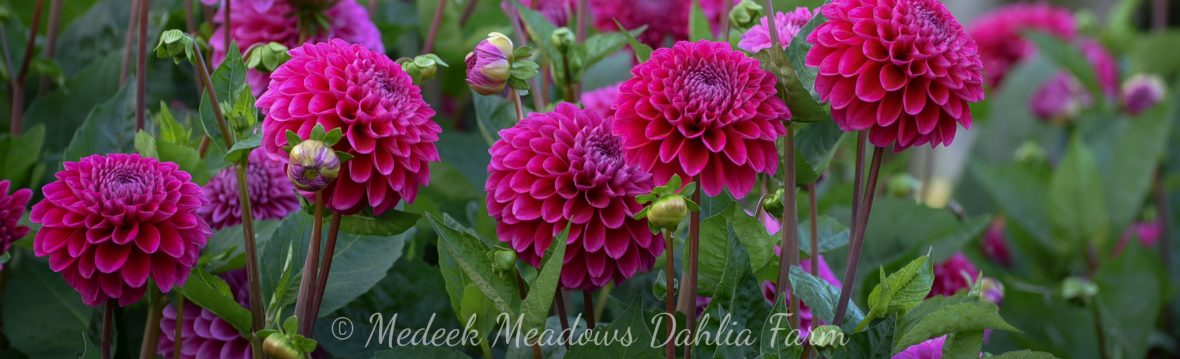
Dahlia Easy Breezy with long stems
Dahlia

Them Stems…The Dahlia Dish January 7, 2025

I love to listen to blues! I love to listen to music when I’m working and I’m 100% sure I’m in good company in that regard! We’re not talking about Chris Stapleton’s cool bluesy tune Them Stems in this post. This is not that, because this is the Dahlia Dish. We’re sharing our thoughts about flower stems. Them dahlia stems.

Great Dahlia Stems

Great stems can be stiff or wirey, thick or thin, hollow or solid, long or short, shades of green or dark shades of red and purple tones. While there is a lot of variety in dahlia stems qualities, when we say a variety has “great stems for bouquets” it generally means that we like using it in bouquets. Great dahlias for cut flowers have stems that we can use easily in bouquets. Some qualities matter more for bouquets, while some matter more for gardens.

After quite a number of years growing dahlias (since 2006) we have never been more thrilled with the stems of varieties in our current collection including our new Skeena varieties. They are almost all double duty dahlias! Great in the garden and great in the vase.

Dahlia Easy Breezy with long stems

Dahlia Stem Colour

Dark stems! Those reddish purple or purplish red stems! We love them in the garden! While the colour of the stems may tend to get lost in bouquets, out in the garden those dahlias with colourful stems are extra gorgeous. Especially when we get a light coloured bloom that is just set off so beautifully by its contrasting dark stems. Gah! Stem colour doesn’t matter so much for bouquets, but it can add interest in the garden.

Dahlia Stem Strength

Stem Strength is important for both bouquets and gardens. Stems should always be strong enough to hold the bloom up under normal conditions and also capable of withstanding cutting, handling, transporting and arranging. Weak stems and weak flower to stem attachments aren’t useful in bouquets or gardens if stems break or flowers break off easily. For some varieties, late season stems can be thinner and not as strong as they were earlier in the season. In our experience we find this to be true for some especially taller and floriferous varieties. Cutting plants like this on the “deeper” side (one or two nodes below where you’d cut for a decent stems length) during the first flush of blooms early in the season can help to keep these plants at a more manageable height over the season and with stronger stems.

Dahlia 2023-038 stem example

Dahlia 2023-038 This is an example of a stem that we did not disbud. It has grown 2 lateral stems about 8 inches below the central bloom. We normally remove these 2 as small buds prior to the stems developing. Often we’d cut the stem at the point where its held in the photo (just above the 2nd node). But here, we intentionally cut the stem “deeper” to keep the plant shorter and bushier.

Dahlia Stem Length

Stem length is most important for bouquets and less so for the garden. For bouquets our favourite bucket/vase/jar/vessel to use for holding after cutting and for arranging bouquets will dictate how long the stems need to be. The buckets we use for holding after cutting are 10.5″ tall. The vessels we prefer for bouquets are 7″ to 9″ tall jars or vases. When we cut blooms, the flower heads need to be proud of the bucket thus guaranteeing that we’ve cut stems that will be long enough and then some for using in bouquets. The top height of our bouquets is usually around 16″ to 18″. This is a good length for wrapped market style cut flower bundles too. When we think of varieties with great stems we like stems to be a minimum of approximately 12″ to 16″ long from the base of the bloom. Cutting the stem for this length may come before, but is often after the first “node” below the bloom. The first node is where lateral buds start growing. This is where the need for dis-budding comes in.

Bucket of Dahlia Flowers

Dis-budding for Stem Length

Most dahlias benefit from a bit of dis-budding, especially when their destination is the vase. Dahlias will have a central bud and at least 1 or more lateral buds that start growing just below the central bud. Initially they look like a bit of a cluster, but as the buds develop their respective stems lengthen and the lateral stems may grow past the central bloom leaving that bloom somewhat hidden “in the plant” with a very short stem. Removing the first one or pair of lateral buds when they are large enough to handle without breaking off the central bud will help achieve a longer stem for the central bloom. Some varieties need more dis-budding than others to achieve better results. We’ll remove just the first bud or pair of lateral buds on some varieties, while on others we may remove up to 5. You’ll soon get to know which varieties are a little less demanding in this regard.

P.S. don’t let those short stems go to waste. Short stems can still be used in small posy style bouquets , single blooms in bud vases, and we frequently use them along the edge of the jar or vase for larger bouquets.

Dahlia Stem Thickness

Thick stems and stiff stems can be challenging to use in bouquets, but we can use them especially if they have a nice 45 degree “chin up” bloom angle. We just don’t want them all to be super thick or super stiff all the time. They are what they are and demand their space in the vase. They can add great structure, while the thinner, wirey stems are more forgiving and can add some whimsey and be easier to work with in arrangements. Thinner wirey stems can be tucked into the vase here and there with ease, whereas chunky stiff stems are better placed in the vase first where they can be happily in place and “worked around”.

The bloom angle and attachment to the stem contributes to the utility of the stems in bouquets. Clock faced blooms (they look straight ahead like a clock on the wall) and navel gazers (blooms that face downward) are harder to use in bouquets, less appealing in the garden, and unlikely to be winners on the show table.

The beautiful blooms of chunky, stiff, short stemmed dahlias are best left in the garden to be enjoyed in our humble opinion! Our favourite dahlias for bouquets always tend to be those that give us great stems for the least amount of work. Not too much dis-budding for good stem length, not too stiff, not too chunky, and always strong enough to hold those beautiful blooms up and also stand up to all the handling between field and final destination.

Dahlia bouquets

Enjoy the Dahlia!

Dahlia Hamari Rose
Dahlia

Best Dahlias for Cut Flowers… The Dahlias Dish Dec. 17, 2024

How can one narrow down the best dahlias for cut flowers to a list of 10 or 20 or 30 or more when there are thousands of varieties to choose from? When you’re growing dahlias for cut flowers, you need to grow quite a few varieties to ensure your bouquets are always beautiful and that they differ from week to week. Having multiple varieties in each colour group or colour palette is important. Having multiple varieties to choose from is important. Having different styles of blooms is important. Having blooms all season is important.

Warning! This is a highly subjective topic, but we hope to give you some ideas that will help you choose the best dahlias to grow for cut flowers.

Our list of favourite dahlias for building bouquets may change over time as we develop and or grow new varieties. And it may also change due to our personal tastes and styles changes. One year we were all about the waterlily blooms, then it was the cactus dahlias that struck our fancy, now its the balls and decorative styles.

We specifically source, select for and grow dahlias that are best for cut flowers. If we can’t use it often in a bouquet, then we’re not likely to grow very many of them and we’re not likely to grow them year after year. The best dahlias for cut flowers must have great stems that are easily used for bouquets and flower arrangements. And they must be floriferous, producing a good amount of blooms over the season.

The vast majority of the dahlias we favour for cut flowers are in the 3-6″ bloom size range and we like a few in the 2″ size range for bouquet accents. We have developed a large collection of varieties that are excellent for cutting, so for the most part we’ll break down our favourites for cut flowers by colour group.

Favourite Accent Dahlias ~2″

Small World (white), Skeena Posh (blush pinky lavender), Skeena Daybreak (yellow), and Skeena Kiss Kiss (red) are favourites.

We like to grow a number of “accent blooms” for bouquets because they add a great deal of interest and texture to arrangements. Typically pompons, miniature ball & decorative style blooms that are approximately 2″ in size work beautifully as accent flowers.

Small World

Favourite White Dahlias ~3-6″

Carl Chilson, Skelmersdale Jayne, Irish Ruffles, Skeena Crystal

White blooms are an excellent staple to have growing because they can be used in so many styles of bouquets all season long.

Dahlia Carl Chilson
Dahlia Carl Chilson

Favourite Blush Dahlias ~3-6″

Skeena Yve, Skeena Posh, CB Snowshadow, Skeena Nana

These are favourites blooms for bouquets that tend to have a white base and blush soft pink or pinky lavender. Odyssey, Tahoma Odyssey, and Daddy’s Girl are excellent too!

CB Snowshadow

Favourite Light or Dark Blend Dahlias ~3-6″

Skeena Easy Breezy, Skeena Harmonies, Skeena Sugar Pie, Blyton Softer Gleam

Blooms with blends of multiple colours are fabulous for tying in solid colour flowers of the same colour palette in bouquets. Some blooms like Skeena Harmonies have an outline of a complementary colour along the petal edges called picotee! Its super pretty.

Blyton Softer Gleam

Favourite Yellow Dahlias ~3-6″

Canoz Jaguar (buttery yellow) , Skeena Hope (soft muted buttery yellow), Skeena Fairy Lights (light and lemony)

Always bright! Always a delight! There are many hues and tones of yellow. The buttery and the lemony tones are on trend for us. The buttery tones pair well with pinks, whites and burgundies. The lemony tones are fun to pair with whites, oranges and lavenders.

Skeena Hope

Favourite Orange Dahlias ~3-6″

Ryecroft Jill, Brown Sugar, Seabeck’s Shirley

The colour of Joy! We. Love. Orange. The thing about orange dahlias is that its such a versatile colour for use in bouquets. Early summer thru to the fall, customers love orange in bouquets all season. When we roll into September, the leaves on the trees start to turn colour and the cooler nights whisper of fall, orange is still a star.

Brown Sugar

Favourite Pink Dahlias ~3-6″

Miss Sarah, Clearview Peachy, Bargaly Blush, Hamari Rose

Pink is forever! Give us all the pink all the time! Again, as with other colour groups there are so many tones and hues of pink. Pastel, barbie, bubblegum, peachy. The list is infinite. Picking a colour palette may help you settle on the varieties that work best for your own preferences.

Bargaly Blush

Favourite Lavender Dahlias ~3-6″

Bloomquist Compare, Skeena Glitter, Snoho Sonia, Robann Regal

We love the soft pastel lavenders. Gorgeous in bouquets with whites and soft yellows.

Some lavenders have a pink tone, and some pinks have a lavender tone. Those subtleties can make a big difference when choosing the best blooms for your bouquets. Sometimes you just won’t know if a dahlia will go well with others until you grow it and use it in bouquets. We take photos of our blooms alongside colour cards to give a sense of the tone and size of dahlias. The colour cards are available for purchase from the American Dahlia Society.

Favourite Coral Dahlias ~3-6″

Askwith Minnie, Flip Flop, Jomanda, Skeena Sockeye

The shades of corals can be softer or darker and depending on the variety lean more into pink, red, or orange tones. We love corals blended in bouquets with whites and yellows. They are also striking when arranged with mauves and lavenders.

Askwith Minnie

Favourite Red Dahlias ~3-6″

Aurora’s Kiss (very dark), Bloomquist Crave (medium dark), Cornel (medium red), Skeena Katie (medium red)

Those dramatic, not quite black, red dahlias are drop dead gorgeous! They go so well with pinks and other tones of red. We love to grow a number of brighter red dahlias to use in our rainbow bouquets.

Aurora’s Kiss

Favourite Purple Dahlias ~3-6″

Twilight Boy (wow colour), Skeena Gem (floriferous), Bloomquist Mojo (vigorous)

Productive purple people pleasers – these favourites are all of that! From incredible colour (Twilight Boy) to exquisite gold tips (Mojo), these dahlias are great choices for cut flowers

Favourite Bronze Dahlias ~3-6″

Hy Patti, Skeena Humpy, Cornel Bronze

Subtle undertones of pink and orange. The bronze colour palette is warm and well suited for exceptional fall themed bouquets.

Cornel Bronze

That’s already quite a few dahlias that make excellent cut flowers. There are so many to enjoy. Discovering which dahlias you find best for cut flowers while building your own stunning collection will keep you, your friends and family in beautiful bouquets for years to come.

Enjoy the Dahlia!

Dahlia

Dahlia Blooms Vase Life…The Dahlia Dish Dec. 13, 2024

Vase life of dahlia blooms varies and is influenced by a number of factors:

1. Number of stems in a vase – A bouquet of 5 dahlia stems can outlast a bouquet with 25 dahlia stems.

2. Maturity of blooms at harvest – Blooms cut when they are approx 1/2 to 3/4 open will last longer in a vase than a bloom cut when fully mature.

Dahlia Bouquet
Fresh Bouquet featuring dahlias: WD Jady, Cornel, Carl Chilson, Skeena 23-074, Skeena 23-047, Dana Iris, & Skeena Rosie.

3. Hydration level of blooms at harvest – Hydration levels of plants are highest in the cool mornings and cloudy cool days. Avoid cutting blooms in the heat of the day. Very hot weather combined with inadequate watering will reduce hydration levels. Strip foliage from stems to ensure it doesn’t rob the blooms of precious hydration.

4. Weather – Bloom quality can deteriorate in cool wet weather – you may notice browning on the tips of petals after a couple days in the vase. Most noticeable on white blooms.

5. Room temperature – Bouquets displayed in cool rooms out of direct sunlight will last longer.

Dahlia Bouquet
Dahlia Bouquet featuring: Megan Dean, Lyn’s Louise, Cream Diane, Skeena Chic, Skeena Pluto, Robann Regal, Barbarry Forum, and Carl Chilson.

6. Water in the vase – make sure to give your dahlia bouquet fresh water especially for the first 3 days when the water uptake is greatest. Fresh water also looks a lot nicer in a glass vase!

7. Style of bloom – Pompon and Ball style blooms last well, especially if they have very firm textured petals like Cornel Bronze. Varieties with softer textured petals tend to have a bit shorter vase life.

8. Size of bloom – Smaller blooms tend to last longer than large blooms.

We use many dahlia bloom styles to create stunning bouquets. We don’t limit it to the Pompon and Ball style blooms just because they can last a little bit longer. They are very round and formal to the eye. Variation in petal and bloom shapes adds much beauty, whimsy and interest to bouquets.

Average vase life for dahlias is 4-5 days + or – by simply ensuring they have their feet in fresh water. You can fuss over them, sear stems, trim stems, add flower food, sing to them, dance for them and you may just squeeze more time.

Dahlia Bouquet
Dahlia bouquet: BQ Compare & Carl Chilson with Skeena Yve, Skeena Jimi, & Skeena Nana. Cosmo and Dusty Miller greens along for the ride.

Enjoy the Dahlia!

#enjoythedahlia #skeenadahlias #terracebc #dahliafarm #dahlias #growbeautifuldahlias #dahliabouquets #freshflowers #flowerfarm #bouquets

Dahlia Bouquet
Dahlia

Dahlia Blooms for Bouquets…The Dahlia Dish Dec. 11, 2024

The bouquet pictured here is created in our classic style! The blooms in this one are from dahlias Cream Diane, Skeena Posh, Hamari Rose, Skeena Hope, Small World, Carl Chilson, Silver Years and Skeena Harmonies.

With so many choices, which varieties and styles should you grow? What qualities should you consider?

Our five main considerations for choosing a dahlia variety suitable for bouquets are Stem Length, Style of Bloom, Colour of Bloom, Size of Bloom, and Floriferosity.

1. Stem Length – nice long stems are preferred – it can mean less time spent disbudding.

The variety pictured here is Skeena Easy Breezy with her very long stems!

Dahlia Skeena Easy Breezy

2. Style of bloom – we prefer a blend of styles. Balls, poms, decorative, waterlily, cactus… Using a blend of bloom styles can add lovely variety and texture to bouquets.

Dahlia Bouquet

An example of a bouquet including Pompon accent blooms (Small World), Formal Decorative Blooms (Lupin Chris and Jowey Veronique), Stellar style blooms (purple Skeena seedling 23-037 and Sandy Couzens an imperfect stellar form with lovely purple picotee edging on its white petals).

3. Colour of bloom – blending colours in bouquets is a bit of an art. One of the reasons we grow so many varieties is that it affords us an extensive array of colours to choose from for building our dahlia bouquets. If you’re limited on space, or just getting started growing dahlias for bouquets, give some thought to the colour palettes that you and your customers are looking for.

A fall colour toned bouquet with gorgeous warm and golden yellow, orange and burgundy tones. Dahlias in this bouquet include Day Dreamer (waterlily style), WD Aunty Dor (Stellar style), Skeena Shan (Formal Decorative style), Skeena Sugar Pie (Formal Decorative), Skeena Gem (Formal Decorative), and Hy Suntan (Ball).

Dahlia Bouquet

4. Size of bloom – we like a range of blooms sizes. From the pompons under 2 inches in size up to about 5 or 6 inches max. Using a mix of bloom sizes in bouquets adds interest, variation and visual appeal.

Dahlia Bouquet

This bouquet shows a range of bloom sizes from about 2″ up to about 5″. We’ve also included some dahlia bud stems that haven’t quite opened yet (a great way to use stems in the fall that won’t have enough time to fully bloom before frost).

5. Floriferosity – growing varieties that have lots of blooms over the season are favoured. Remember to pinch plants to encourage lateral branching and more stems. And remember to disbud to get more usable stems per plant.

6. Space – if you’re limited in growing space, you may just want to pay a bit more attention to size of bloom and floriferostiy. It takes more small blooms to fill out a bouquet than larger blooms. A garden of pompons would be delightful, but also much harder to fill out a bouquet with such tiny blooms.

Enjoy the Dahlia!

#enjoythedahlia #skeenadahlias #terracebc #dahliafarm #dahlias #growbeautifuldahlias #dahliabouquets #freshflowers #bouquets

Dahlia

I told a friend…The Dahlia Dish, March 25, 2024

One of the things that fascinates us about dahlia blooms is that there are so many beautiful varieties that haven’t or never seem to “make it big”. They take their time to catch on. They sit a little longer on the shelves, they wait like wallflowers for an invite to dance, they might be the last players to get picked to play on the team…Why?

Dahlia Bargaly Blush

The visual appeal of a flower might be a combination of preference for just two qualities: colour and form. The functional appeal of a flower is how well it serves the needs of the grower in the garden and the vase: think stem length, bloom time, “floriferosity”, vase life, tubers and also colour and form.

If a bloom meets both visual and functional appeal is it guaranteed to be a winner? Is it going to hit the big times? Is it going to be the next Hollywood star in your bouquets and gardens? Maybe! Much more likely if it gets airtime! And much much more likely if the hype is not an empty promise that eventually sends the bloom down the road of ambiguity.

The volume of street chatter needs to get loud enough for dahlia growers to hear the call of a dahlia name more than once or twice and in a favourable tone. Often this chatter starts from a dahlia society or from a dahlia show where top prizes are coveted. Word of mouth is powerful! Remember that fabulous Faberge Organics Shampoo TV commercial starring actress Heather Locklear? “…I liked it so much I told 2 friends about it, and they told 2 friends, and so on, and so on, and so on”… that very same phenomenon happens with dahlias…

Dahlia Cherish

Dahlias that are on either side of the limelight are excellent choices for the vase and garden because they can usually be found at reasonable and in some cases low prices whereas those unicorns directly under the bright lights of stardom can cost a pretty penny, an arm or leg, maybe even your firstborn! Varieties on the bleeding edge of limelight are usually lesser known or new to the scene, while classic varieties that were once in the limelight have been around for awhile, are well known, readily available and have great qualities. Classics are a fantastic choice for new growers and seasoned growers too if they’ve never graced your garden.

2023-036 Medeek Meadows

A few varieties that we think are on the bleeding edge of limelight because of their visual and functional appeal, relative scarcity or obscurity and incredible qualities include: Bargaly Blush, Island View Moon, Cherish, Clearview Peachy, Aurora’s Kiss, Daddy’s Girl, After Dusk, Jabberbox and Ferncliff Classy.

A few solid classics that we adore and love to grow include: Carl Chilson, Ivanetti, Cornel, Robin Hood, Jowey Paula, Nijinsky, Just Peachy, and Snoho Sonia.

Dahlia Jowey Paula

Remember! The beautiful dahlias on both sides of the limelight are often just as incredible as the current “stars” and “unicorns”! Tell a friend!!!

Grow Beautiful Dahlias!

Enjoy the Dahlia!

Dahlia

What in the influence?!?… The Dahlia Dish March 19th, 2024

Our Boppa grew dahlias in the gardens by the house at the farm on Oldfield road and I wonder if he didn’t grow them would I be growing them today? As a kid, I remember being particularly enamoured with the huge yellow blooms of Kelvin Floodlight. They made a huge impact! So much so that when I bought my first house 30 years later and finally had my own gardens, I planted my first dahlias along with green arrow shelling peas (because they are AMAZING too and great snacks if you like snacking straight off the vine)! There was no internet back in the early 80s so exposure to beautiful dahlias was limited to seeing them in the gardens of friends and family, via a visit to the dahlia display at the Butchart Gardens, via local Dahlia Society events, or the exhibition hall at a fall fair (our closest was the Saanich Fall Fair). Since that first house, my gardens have never been without dahlias! But… unlike my Boppa who seemed to grow the same varieties year after year, I find myself continuously enamoured by new varieties with their fabulous forms and colours.

I did grow Kelvin Floodlight for the sake of sentiment and nostalgia in my early gardens. But new factors influenced my decision to stop growing it. Its a show stopper to be sure due to its magnificent size and bright yellow colour but its too big for the average bouquet and is also a later bloomer so not the best choice for me with the shorter growing season where we live in Terrace in Northwest BC vs the Victoria area on Vancouver Island…. so KF had to go! Tough choices when you have limited space and certain requirements (i.e. must be able to use in a bouquet)!

Availability and access to new varieties ramped up exponentially since the internet became a thing… and then even more so in the last 20 years +or- as smart phones and social media on the internet became things… Thinking back to around the year 2005 I was working for a well-loved airline called Hawkair. I remember Captain Lopes showing us this new “app” called Facebook where you could sign up for an account and connect with friends and family no matter where they were in the world so long as they had accounts too “for free”! Wild! Smartphones with cameras enabled the ability to connect to the internet and share photos of beautiful dahlias in just seconds!!! Internet + Social Media + Smartphones = Dahlia Awareness to the nth degree! You might also call this influence…

Ever wonder how many photos of beautiful dahlias have been shared via social media?! Sooooo many! We can admire seemingly limitless photos of dahlias 24/7/365! Anytime, any day, all year long! We are under the influence!!!

Dahlia Skeena Posh and Chic

Over the years I find that my preferences for colours and forms of dahlia flowers changes… but the 1 thing that stays constant is my appetite for new varieties. The thrill of watching a new variety bloom for the first time! Its so exciting to see it bloom in the garden for the first time! When I see these new blooms, I can’t help but start to compare them to varieties I’ve grown before. Which do I prefer and why? Practicality and the attributes of the variety itself are ultimately what influences me the most when it comes time to decide if I will continue to grow it or not.

What influences your decision to grow a new variety? Is it the colour? Is it the form? Is it the growth habit? Is it because “everybody” wants it? Is it sentimental? Is it the name of the variety? Is it because it blooms earlier? Is it because its a blooming powerhouse? Is it the size of the bloom? Is it the tubers? Is it the stem length? Is it practicality? Is it show worthiness?

Dahlia Bouquet

Whatever the influence!!! Enjoy the Dahlia!!!

Dahlia Bouquet
Dahlia

Dahlia Bouquets… The Dahlia Dish March 13, 2024

When there are so many beautiful flowers in the world , you might wonder why choose the dahlia? Why is the dahlia so wonderful for bouquets? We think we know the answers! There are A LOT of reasons!!!

Firstly, dahlias are available in almost every shade and every hue of every colour unlike many flowers that are available in just a handful of standard colours. There are sooooo many colours! So many! You’ll find dahlias in the colour groups of White, Yellow, Pink, Orange, Red, Purple, and Bronze. No Blue… and I don’t think we’ve ever seen a Green or a Brown dahlia bloom, but genetically these may be possibly whereas Blue is not.

Additionally, unlike most other flowers, dahlias are available in multiple magical forms and styles! Forms are defined by the general shape of the bloom, the shape of its petals, the number of rows of petals, the arrangement of the petals, open centred (like a sunflower showing off its central disc), or closed centre (the central disc is not visible until the flower is fully matured and spent). Its true that some dahlias can look quite a bit like other flowers such as Asters, Peonies, Daisies or Waterlilies!

Dahlia Lavender Lovers Bouquet

The shapes! The general shape of the flower can be round like a ball (Ball and Pompon), flatter like a plate (Decorative), cupped like a saucer (Waterlily). The shape of the petals in each bloom are another source of incredible variation in form! Petals can be pointy, rounded, incurved, recurved, reflexed, wavy, curly, flat, elongated, tubular… The shape of a dahlia bloom’s petals further define forms of Cactus, Semi-Cactus, Informal Decorative, Formal Decorative, Novelty, Anenome, Peony…

The petals! The number of petals in a bloom further contribute to the appeal of dahlias. Some are Singles… open centred having a single row of petals around a central disc. Others are Doubles… multiple rows of petals around the central disc, some with a closed centre, some with an open centre.

Dahlia Bouquet

The size of the blooms! As tiny as 1″ across (Pompons) these are perfect for bouquet accents… to larger than 10″ across (multiple forms such as Decorative and Semi-Cactus often referred to as Dinner Plate sizes) that are spectacular to use for focal flowers in event or bridal bouquets. There is a dahlia bloom available in every single size you desire for a bouquet! We favour those that are up to 6″ in size for daily bouquets.

The stems! Dahlia stems can differ by variety too! Some are super stiff and straight up, while others are more wiry or bendy and perfect for whimsy. We like the full range of stems for use in bouquets so long as they are long enough to use!

Dahlia Bouquet

The bloom window! Dahlias offer blooms for a long period during the summer! Bloom time varies by variety. Some will bloom earlier in the season and some will bloom later. We favour the earlier to mid season blooming varieties because we want them for bouquets as early as possible in the season. We do love to have a few later blooming dahlias in the queue to contribute to the ever changing variation that adds interest to our bouquets all season long. And remember! Dahlias are known to be cut and come again flowers! The more blooms you cut for bouquets, the more blooms you’ll get!

The possibilities of creating beautiful bouquets using dahlia blooms are endless! The colours, the forms and styles, the sizes, the stems, the bloom window! Dahlias make it fun and easy to create beautiful bouquets enabling the spread joy and happiness!

dahlia tubers canada

Tips for beautiful bouquets:

  • Choose colours that work well together! If the tone or shade of a particular variety isn’t quite right, save it for another bouquet. Sometimes when we grow a new variety, we find that the colour might be gorgeous but also awkward because we don’t have any other dahlia blooms that go well with it. If we really love the colour, we’ll use these as focal flowers in bouquets using other flower types and greens as filler. And if we really really love the colour, we’ll start trying to source more dahlia varieties to complement it and we will often grow more of that variety.
  • Threes work well! 3 varieties with colours that complement, 3 stems of each bloom… or multiples thereof.
  • Bridges and blenders! Many dahlias are bicolour or have a blush or a kiss of a secondary colour. These are perfect for tying in colours in a bouquet! Cherish is a pale yellow with a pinky purple burgundy kiss that is incredible for using in bouquets to tie in with other blooms of pink, purple, or burgundy. Bowser Denyse is a beautiful pink bloom with white petal tips that help to tie in white blooms or other pink blooms….
  • Fillers! While we are quite partial to a vase full of just dahlias, filler flowers and greens are always handy and afford variety, texture and interest to bouquets. Some of our favourites are zinnias, cosmos, honeywort, bouquet dill, peony foliage, marigold gem, feverfew, borage, statice, asters, strawflowers, phlox, euphorbia, eucalyptus and in mid-late September we love to use dahlia foliage for greens in bouquets!
  • Freshness! Fresh flower bouquets are not meant to last forever. Dahlias typically last about 5 good days in a vase. Cut blooms before they are fully mature ~1/2 to 3/4 open. They may open up a wee bit after blooming but generally not much and hardly at all if cut at the 1/2 to 3/4 open stage. Cut blooms in the cool of the morning and place directly into cool clean water. Keep the water in the vase fresh – change it daily if possibly (most importantly in the first few days while the stems are still taking up water). Bouquets displayed in a cool area will last longer than bouquets displayed in a warm area.
dahlias Canada

Grow Beautiful Dahlias!
Make Beautiful Bouquets!
Enjoy the Dahlia!!!

Dahlia
Dahlia

All the ways to mix up dahlia varieties… The Dahlia Dish January 14, 2024

The humble gardener knows that even with years of experience growing dahlias its dead easy to mix up tubers leading to unknown and mislabelled varieties. There are folks who aren’t at all interested in tracking the names of the dahlia varieties they grow. If you’re in this group, you still might find it handy to label varieties according to height and colour so you know where best to plant them in your garden (i.e. short pink vs tall pink is about all you need on the label). Then there are folks who meticulously label and track every variety by name and number (call me crazy but count me in!). I need to know who’s who in my zoo… I love the names! A name has meaning – it has a story – familiarity – and maybe even gives our gardens a bit of personality!

Buckets of Dahlia Blooms

Its almost impossible to grow just a single variety of dahlia. It can be done, but why would anyone want to? …I’m not judging you’re judging 😉 … Back to the topic of this post, mixing up tubers. You’ll never do it if you only grow one variety!

Top 10+ ways to mix ’em up (in no particular order of “likelihood”)

  1. Buying tubers
    • Somebody else did it! Somebody already mixed up the tubers before you got a hold of them! Instead of seeing the beautiful soft yellow bloom of “Cherish” gracing your garden for the first time, you find yourself scratching your head gazing at a tall peachy pink beauty and wondering what the heck is this?
  2. Planting time
    • Mapping mistakes! You didn’t plant “Jabberbox” where you planned to and then you didn’t update your map and then you forgot what you did in the spring and then “Carl Chilson” shows up where Jabberbox was supposed to be… summertime gets busy!
    • Most gardeners do not plant their dahlias in rows with 1 variety per row and marked/mapped accordingly. Maybe your dahlias are sprinkled throughout your various garden beds beautifying your landscape over the summer. Mapping along with a labelled tuber or a labelled stake by each dahlia can help you keep things straight.
  3. Verification and correction of mistakes
    • When the blooms are bountiful, it’s the perfect time to check that labels match varieties and correct errors. If you have errors and don’t fix them during the blooming season, you won’t get another chance and will be more likely to perpetuate the mix ups next season and possibly for other people if you’re sharing your bounty of tubers.
  4. Digging
    • Remember when it comes time to dig up the dahlias in the fall, there’s often a good chance that the blooms are long gone. While tubers can have “distinguishing” characteristics, they usually aren’t obvious enough to determine what variety you’ve just dug up. Once the blooms are gone there isn’t much else aside from a good labelling/mapping system to identify the variety. If you’re growing multiple varieties in the same garden beds, a good labelling system is helpful.
    • Digging and processing one variety at a time will minimize the chance of mix ups
  5. Processing & Packing for storage
    • Again processing one variety at a time helps to minimize mixups
    • If you come across a stray tuber or clump of tubers that you’re not positive “belongs”, make a note of it and label as “mystery” accordingly
    • Watch out for spills! Sometimes the work area can get crowded! Safety first! Minimize tripping hazards. Carry only one tray of one variety at a time! You wouldn’t be the first to dump a tray of “healing” tubers that lands in another tray of another variety.
    • Avoid placing multiple varieties in the same bin! Stick to one variety per bin. Label each bin and place another label inside the bin with the tubers.
    • Be wary of old labels on bins. Plastic storage bins should be washed after every use and old labels removed.
  6. Winter Storage
    • Always a good practice to check on your tubers from time to time during the winter months to ensure they’re storing well. As with digging and processing, when checking tubers in storage, check one variety at a time to minimize opportunity for mix ups.
  7. Multi-tasking
    • One job at a time!
    • If you think you’ll remember, you won’t! If you think you’ll forget, you will!
  8. Labels on plants
    • not all labelling methods work well out in the garden. Regular sharpies work “ok” but not great and are very prone to fading away to the point of being illegible at the end of the season when you really need to be able to read the label. The finer the tip, the faster the fade. Use an indelible ink permanent “Nursery Marker” – they are the bomb. Whether they are in direct sunlight or hidden in the ground – they are 100% legible at the end of the season.
    • label one variety at a time! Applying the wrong label to the wrong tuber has been done before!
    • We like to use a combination of different coloured surveyors flagging tape on plants when needed, and we use wired vinyl labels on tubers before we plant them.
  9. Cuttings
    • mislabelling a tuber is one thing…
    • when you take cuttings from a mislabelled tuber – you unknowingly propagate 5 plants of a variety – but which variety? Maybe you’ll get 5 “Crazy Love” plants instead of 5 “Peaches N Cream” plants! Be cautious – it can happen. The risk can be higher with cuttings taken from “new to you” tubers which you have never grown before and thus never had the chance to verify the blooms match the name.
    • mixups in the trays can also happen by taking a cutting and putting it in the wrong tray to root…
  10. All the varieties!
    • the more varieties you grow – the more important it may be to develop good habits and good systems if you want to keep an accurate inventory.
  11. Helpers
    • Pets and little people have been known to move things around and maybe even chew up labels! Double or triple labelling redundancy can be helpful 😉

At the end of the day… find a system that works for you! Grow beautiful dahlias! Enjoy the blooms and share the joy!

dahlia tubers canada
Dahlia

Dahlia tubers or cuttings or seeds?…the Dahlia Dish January 8, 2024

All the ways to grow beautiful dahlia blooms… from tubers, cuttings, or seeds? Which way and why?

Dahlia Jabberbox

Dahlia Tubers

Our #1 choice. Growing dahlias from tubers is the easiest and most reliable way to grow dahlias “true” to variety. This is by far our preferred way to grow dahlias. The benefits:

  • easy as pie – they require the least of amount of work, equipment, supplies, and time.
  • they are more forgiving than a cutting. When you acquire new tubers, they don’t usually require too much coddling from the time you receive them to the time you can plant them (after your frost free date). Store them in a cool, dark area until you’re ready to plant. Keep an eye on the humidity so that they don’t shrivel up if its too dry. Plant them out when the weather looks favourable.
  • if you happen to get a late frost after you’ve planted your tubers where the frost kills off the new growth, as long as the tuber is in good shape it will usually do its best to put up new shoots and carry on growing. While your plant may get set back a couple weeks, it’ll still grow from the tuber and produce some nice blooms for you.
  • All growing conditions being equal, our own experience has shown us that dahlia plants grown from tubers consistently produce more viable tubers (tubers with eyes) to harvest in the fall than the same variety grown from cuttings.
  • while dahlia tuber “mothers” can and do sometimes succumb to rot after planting out, the young plant can often be saved simply by gently digging up the plant and removing the rotting tuber and then replanting. A young plant that starts to look “wilty” or fails to “take off” is a sign to check the mother tuber for rot.

Dahlia Cuttings

Our less appealing choice for growing dahlias true to variety is via cuttings taken from tubers. We’re sometimes asked if we sell dahlia cuttings and our answer is “no”. Growing dahlias from cuttings is not new… but…interest in growing dahlias from cuttings spiked in Canada in 2023/24 possibly sparked by the desire to provide or acquire “unicorn” varieties that are new, hard to find, or stingy tuber producers. Some will find success in buying and selling dahlia cuttings in Canada and some will not. A cutting taken from a plant can be used as a sort of “insurance” that you don’t lose a plant (ie. varieties whose tubers don’t store well or one that doesn’t produce many or any) or to capture a sport or simply to acquire a new variety. If you’re intent on growing dahlias from cuttings, you’ll still get some nice blooms, but temper your expectations for tubers. The cons of cuttings to be aware of :

  • Disease, if present, is propagated faster. Cuttings should only be taken from clean stock that is known to be disease free. If a tuber happens to have a disease and 10 cuttings are taken from that tuber – you’ll achieve 10 diseased plants. There is also risk of spreading disease amongst cuttings taken from “clean stock” if they share a tray with a diseased cutting or if sanitation of tools used to handle and take cuttings is inadequate.
  • Growing from cuttings demands additional care and attention and resources. Cuttings require more work, equipment, supplies, time and knowledge than growing from tubers.
  • Cuttings are more fragile and are more difficult to ship successfully than tubers. Failures during shipping are more common with cuttings than tubers due to the sensitivity of young plants and the shipping conditions they must endure.
  • When you receive a cutting, you may need to pot it up into a larger pot right away to prevent it from getting root bound (if you’re hoping for tubers) unless you intend to grow it on as a pot tuber. You may need to get it under grow lights until your frost free date allows planting out so that it doesn’t get weak and leggy.
  • If new growth on a plant grown from a cutting gets killed off by a late frost, there is little chance that the new root system will be able to put up new shoots leaving you with an empty space to fill in your garden.
  • Tuber production from cuttings can be hit or miss. Cuttings that become root bound stay root bound. Some varieties may do better with regards to producing tubers than others. The method used to take a cutting may influence tuber production. If your cutting doesn’t produce tubers, you might need to accept that you’ve grown a dahlia like an “annual” and try again next season. As with growing from tubers, some varieties are known to be great tuber producers, while others may only produce a few.
  • Splitting clumps of tubers grown from cuttings is not as satisfying or enjoyable as splitting clumps grown from tubers! They are often “hairy” with lots of feeder roots and few viable tubers to harvest. It takes more time to get the job done, and with fewer viable tubers at the end of the day.
  • Waste! There is typically a lot of plastic used in the process of generating cuttings. Plastic pots, trays, and shipping containers. While some of it may be recyclable requiring more energy to process and reuse, much of it ends up as trash in landfills.
  • The price point… How much are you willing to pay for a cutting? What should the price be? Should it be more or less or the same price as a tuber of the same variety? Would you expect a cutting to cost less because they don’t always produce tubers and often they produce fewer tubers than a plant grown from a tuber? Demand and time will tell…

Seeds

Dahlia seeds do not produce dahlias true to variety. This means that seedling blooms usually look substantially different from their parent dahlias. Growing dahlias from seeds can be fun but is not for everyone because you just never know what you’re going to get! Colour, form, height, growth habit etc can be so wildly different! Genetically dahlias tend to revert to their less desirable traits – single blooms on tall plants. Dahlias grown from seed will usually produce tubers that can be harvested in the fall to store over the winter if you like them well enough. Growing from seed is how new varieties are developed and they take a bit of time (at least 2 years) to come to market and longer to become widely available.

Dahlia seedling 2023-007

Hopefully you find these musings helpful… may you have a ton of fun growing beautiful dahlias from tubers, cuttings or seeds this year!

Dahlia

Early Dahlia Blooms…musings – The Dahlia Dish July 14, 2023

When all your friends are happily sharing their first dahlia blooms…its mid-July already and your own dahlias are “taking their sweet time” to bloom …. Why!?!

Medeek Meadows Dahlia Seedling ID: 2022-049
First Bloom Date: June 28
Started early indoors: Yes
Locale: Terrace, BC, Canada (frost free date approx mid-May, first frost date approx mid-October)

“All good things come to those who wait” may be true! But! If you really want the earliest possible dahlia blooms gracing your garden, there are a few things that you can do. Here are some tips that might help you get earlier blooms next season…

  • Select dahlia varieties that are known to be earlier bloomers (our website shop includes a filter for “bloom time” that you might find helpful)
  • Give your dahlias a head start by eyeing up the tubers and potting them up indoors
  • Pot up (transfer to larger pot as necessary) your early indoor starts and transfer them to an outside greenhouse when temperature permits
  • Transfer those greenhouse plants to the outdoor garden after your frost free date
  • Plant your earliest varieties first and put them in the prime location of your garden – where they get all the sun and all your attention!
  • Ensure your dahlias are well fed from the start. Doing a soil test is helpful for both the novice and experienced gardeners. Fertilizers can be expensive – relatively inexpensive home soil test kits can help you determine exactly what nutrients you need to target. Garden soil is often nitrogen poor, which leads to lack of vigour and susceptibility to disease and slow growth. Be careful with adding too much nitrogen – you want a good balance – follow recommendations for application from your soil test!
  • Avoid crowding your dahlias such that they get outcompeted by their neighbours which may set them back.
  • Elliminate bugs and slugs that will set your dahlias back and in turn delay blooming.

You don’t NEED to do any of the above! Aside from selecting “early varieties”, the rest all take extra time, effort, and resources. If you prefer the “keep it simple and easy” type of gardening, its just fine to plant your tubers out directly into the garden near your frost free date and let them do their thing. Depending on your location in Canada, your first blooms will start appearing anywhere from June (early varieties in warm locales) thru September (late varieties in colder climates). In Terrace BC, dahlias really start putting on their show in late July. They are a favourite flower for so many folks for so many reasons and in particular because once they start blooming, they bloom continuously until the first frost (remember to dead head plants to keep them blooming).

Medeek Meadows Dahlia Seedling ID: 2022-056
First Bloom Date: July 11
Started early indoors: Yes
Locale: Terrace, BC, Canada (frost free date approx mid-May, first frost date approx mid-October)

…until next time, we’ll be out in the garden paying special attention to disbudding for longer stems and better blooms…enjoy the ride…take time to smell the roses…Grow Beautiful Dahlias!